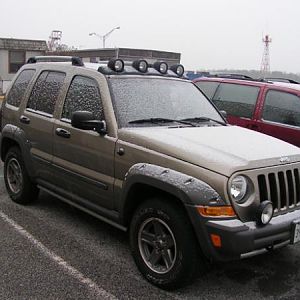
I'd leave a little slack in that cable. There is a reason the manufacturer specifies some slack. You don't want to ride your brakes in the towed car.
You absolutely are not having any mechanic or hydraulic advantage added to the Liberty in this condition. All you have is 'dead stick' brakes.... Meaning, exactly as if you were to lose the engine at speed and apply the brakes a few times... You have enough vacuum assistance (assuming an airtight vacuum system, no leaks) for 3 or 4 applications of brakes. After that it's simply the little bit of mechanical advantage you get from the architecture of the brake pedal to the hinge, to the actuation rod into the cylinder. Also, the fact you are running a hydraulic brake system gives quite a bit of MA as well.... This can be compared to an old cable-pulled mountain bike brake system vs hydraulics.
I could go a lot farther into this subject, but it isn't necessary.
TLDR - you have some mechanical advantage to the braking system, but no boosting (because the vacuum or hydraulic booster <depending on the build I- think the diesels had hydroboost?> due to either the hydraulic system <PS pump> or vacuum system <gas engine is a huge vacuum pump, remember> not running. The pull cable from the towbar manufacturer is likely providing less braking than you would if you were to press the brake pedal, as it is pulling from the other side of the lever/fulcrum that is the brake pedal assembly.... Which IIRC, is not as long as that same fulcrum to the brake pedal.